

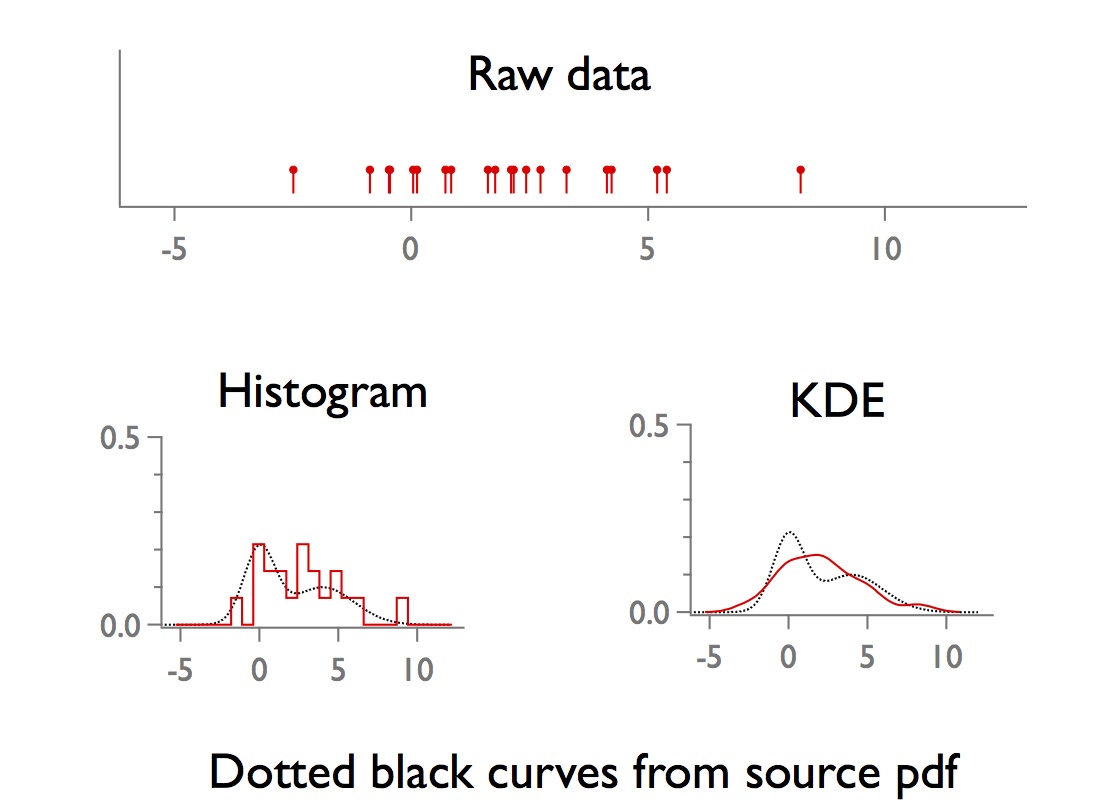
kernel density estimation (1d)

FastGaussTransform Caution:
FastGaussTransform kde is particularly nice for 2d (bivariate) data. One advantage is that you can generate smooth contours from the estimated pdf.
FastGaussTransform
Function kde(w,bw)							// 1d kernel density estimation (Gaussian kernel)
	wave w; variable bw                                           // w must not contain NaNs
	variable n=numpnts(w),kde_norm,  xmin=wavemin(w)-2*bw, xmax=wavemax(w)+2*bw
	variable nx = min(round(100*(xmax-xmin)/bw),100)
	make /d/free/n=(n) wweights=1
	FastGaussTransform /WDTH=(bw)/RX=(4*bw) /OUT1={xmin,nx,xmax} w,wweights 	// you may need to tweak /RX flag value
	wave M_FGT;  kde_norm=sum(M_FGT)*deltax(M_FGT);		M_FGT /= kde_norm
	string wn=NameofWave(w)+"_kde";	duplicate /d/o M_FGT $wn
	killwaves M_FGT
End

Forum

Support

Gallery
Igor Pro 10
Learn More
Igor XOP Toolkit
Learn More
Igor NIDAQ Tools MX
Learn More