

StatsTTest Values?



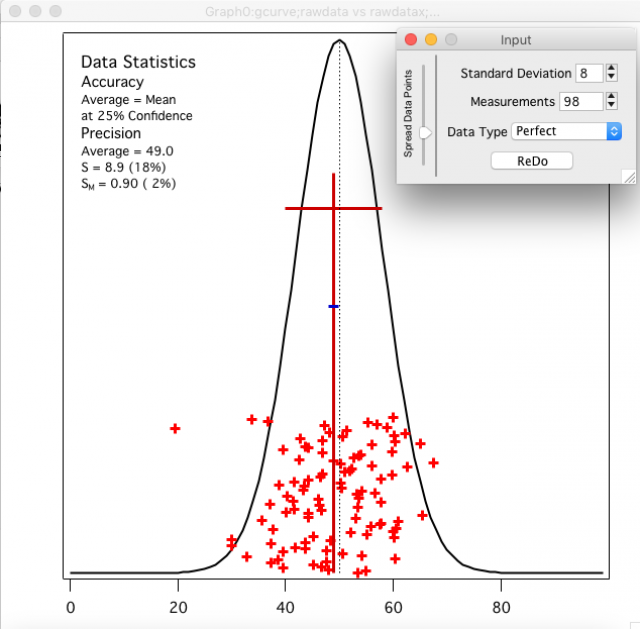
I am designing a demo for a class. It shows a "theoretical" normal distribution. It adds "raw data" to the distribution (using gnoise()). I want to return a report on the Accuracy of the raw data to represent the theory.
I understand the hypotheses tests based on t and tcrit. What is confusing me is the P value. Is this a probability of the null hypothesis being true? Or vice-versa? Or something else?
Alternatively, what might be a better message to report on this demo about the accuracy of the "raw data" relative to "theory" (an infinite population size).
Yes. As for a better message: there's a nice video by Geoff Cummings called Dance of The P-Values, which illustrates the point you are (I think) trying to make. It's on youtube and highly recommended.
February 26, 2016 at 06:34 am - Permalink
--
J. J. Weimer
Chemistry / Chemical & Materials Engineering, UAH
February 26, 2016 at 10:03 am - Permalink
The null hypothesis in this case is that the means are equal. The P value is the probability that 't' is outside the critical values by chance. This is the area under the t-distribution curve away from the +-critical value (for two tails).
The "Dance of the P-Values" is indeed a very nice example that should not be difficult to reproduce in IGOR.
A.G.
WaveMetrics, Inc.
February 26, 2016 at 10:12 am - Permalink
Thanks. I am heading that way. My latest iteration shows as in this figure.
I hope to post the demo here soon. Including a way to "build the stats in steps" may have to be something I do as a summer project.
--
J. J. Weimer
Chemistry / Chemical & Materials Engineering, UAH
February 26, 2016 at 11:55 am - Permalink
I hope folks in education might find this tool can help them explain the concepts of precision and accuracy to students. Indeed, the driving force for me to make it was a realization that students in undergraduate chemistry labs seemed to have no clue what the concepts really mean. Even I learned some important things by the time I was done.
Enjoy!
--
J. J. Weimer
Chemistry / Chemical & Materials Engineering, UAH
March 1, 2016 at 08:54 am - Permalink
March 1, 2016 at 02:24 pm - Permalink