

ISO General method to find divergence in experimental data



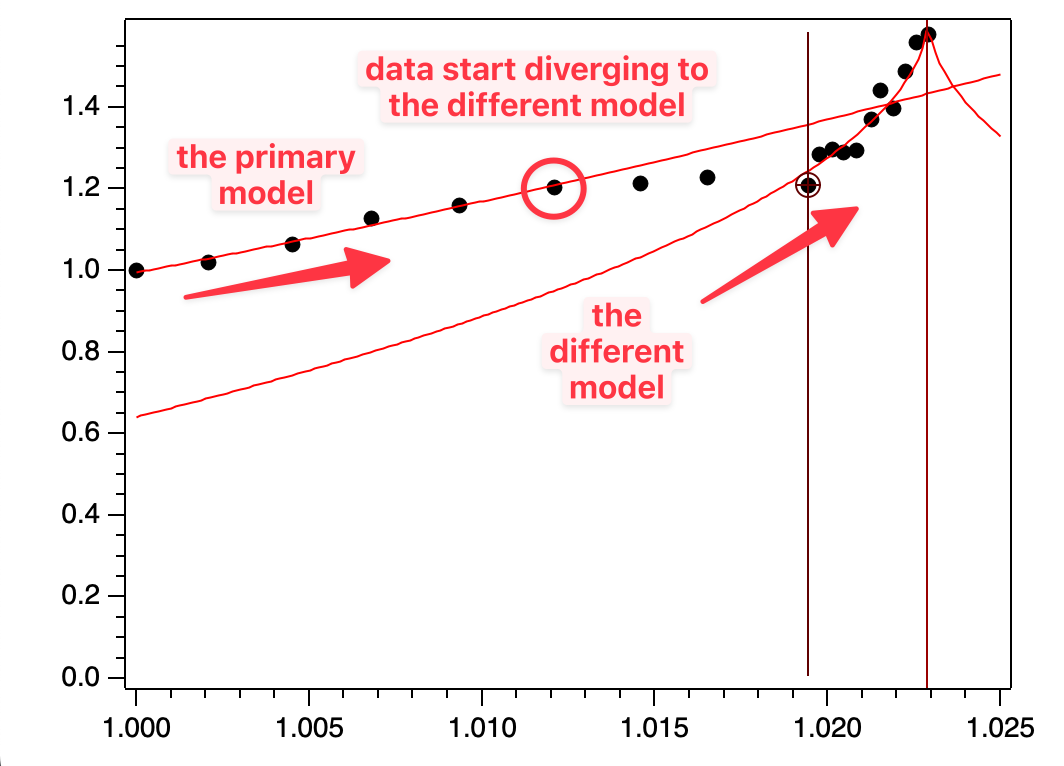
I have an analytical equation that I am fitting to experimental data. The data should fit the model specifically up to a certain point. The data should diverge after that point to a distinctly different analytical model.
The experimental data scatter. They may or may not have uncertainties on each data point.
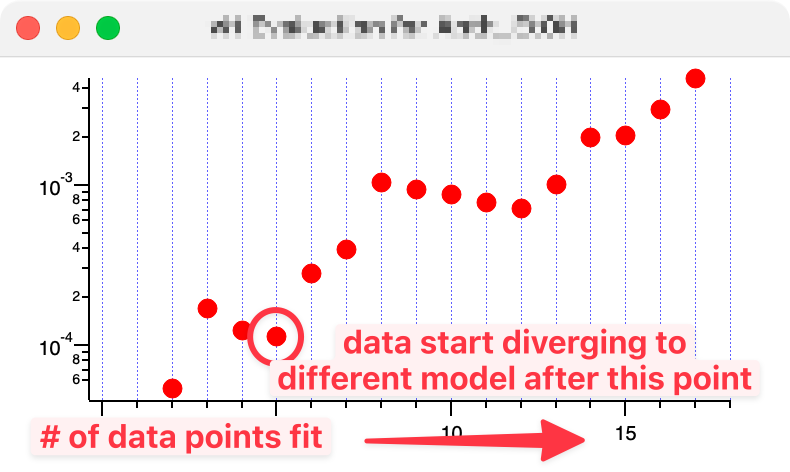
I am seeking a generally accepted way to determine the best point where the data diverge from the analytical equation. My thought is to use an expression G = chi^2/(N - P) (reduced chi^2), where chi^2 is chi-squared, N is the number of data points being fit, and P is the number of fitting parameters being used (2 in this case). I plot G versus N and look for locations where the plot falls and jumps. I chose this approach based on a gathering of information that G should approach unity in a best fit case.
I have applied this approach across a dozen or more data sets with quite good success. See the attached figures for an example. For this set, the data points scatter but were only recorded once (they have no associated y-value uncertainties).
Also, in general, from the majority of my tests so far, I consistently get G << 1 over fitting ranges where I am certain the data is not diverging to the new model. I suspect the result is because I have no weightings for any of the data points.
I would appreciate any insights, especially whether my approach to discern a divergence is within acceptable reason.
I have never done a fit like that, but couldn't you simply try to include the divergence X value as a fit parameter?
Maybe you have to first force the divergence point to the center to get reasonable starting parameters for the two models, but after that you could do a finer fit where you let the divergence point free to move.
June 26, 2026 at 03:56 am - Permalink
I am hesitant to build an analytical fitting model that includes both branches and the transition point for a host of reasons.
I the meantime, I've used the approach with a plot of reduced chi^2 versus fitting point to investigate over two dozen different systems. I am fairly confident in reporting the approach as an objective way to set a best value on the transition point.
I am glad to add further insights off-line if anyone is interested.
Thanks!
June 26, 2026 at 09:37 am - Permalink